Whole-Book Translation
Translating a whole book is not translating a paragraph many times. The hard part is consistency across hundreds of thousands of characters: one character's name cannot be rendered three ways, one term cannot shift between chapters. And patience — feeding a chat model paragraph by paragraph burns an afternoon on copy and paste alone.
Upload a book to start translating
Geyi takes the whole book at once. Upload it, let it run, and come back to a finished file. Closing the page does not interrupt anything.
Geyi book translation takes the whole book at once: upload it, let it run and come back to a finished file. A personal glossary keeps names, places and coined concepts consistent across hundreds of thousands of characters.
Key capabilities
- Whole-book processing that keeps running after you close the page
- Personal glossary for names, places and coined concepts
- Very long books can be split by volume and submitted as several files
- Exports EPUB, Word, PDF or Markdown
- Optional bilingual PDF and Word, gated by plan tier
How consistency is held
The personal glossary is the single most useful feature for long documents: pin the renderings of names, places and coined concepts, and the whole book uses one set. Edits take effect on the next job, with no need to rerun what is finished.
Terminology also stays consistent within a single job — a direct benefit of processing the whole book rather than scattered fragments.
When a book is very long
The per-file size cap and the number of concurrent jobs depend on your plan. Past the cap, split by volume or part and submit several files; each is billed separately and each result waits in History. The glossary applies across jobs, so splitting does not break consistency.
Splitting has a second benefit: run the first part, confirm the tone and terminology are right, then submit the rest — far cheaper than discovering the problem after the whole book has run.
What you get
- EPUB: straight into a reader, chapters and contents intact.
- Word: for continued editing or typesetting.
- PDF: for printing or archiving.
- Markdown: for a notes library or writing setup.
- Bilingual output (optional, gated by plan tier): a PDF and Word pair with the two interleaved.
Geyi compared with generic machine translation and a manual workflow
The generic machine translation and manual workflow columns describe common cases; actual results vary by tool and method. The Geyi column lists only capabilities that are live in the product today.
See it in action
Four opening pages of the 1917 Rashōmon scan are translated through high-precision reflow and then reviewed paragraph by paragraph as horizontal Simplified Chinese. Furigana leaking into prose, clothing and time references, and page-break joins are corrected for display.
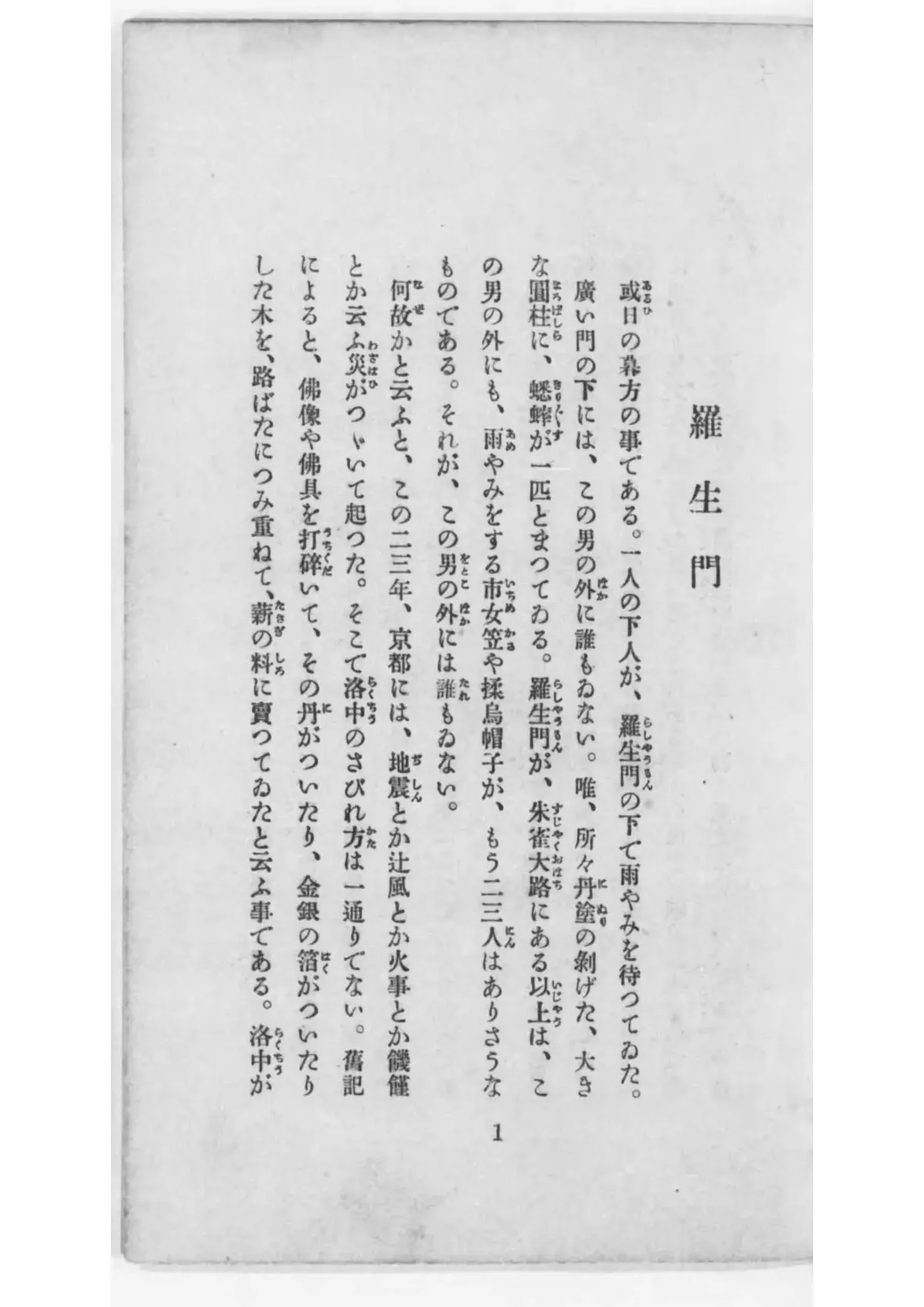
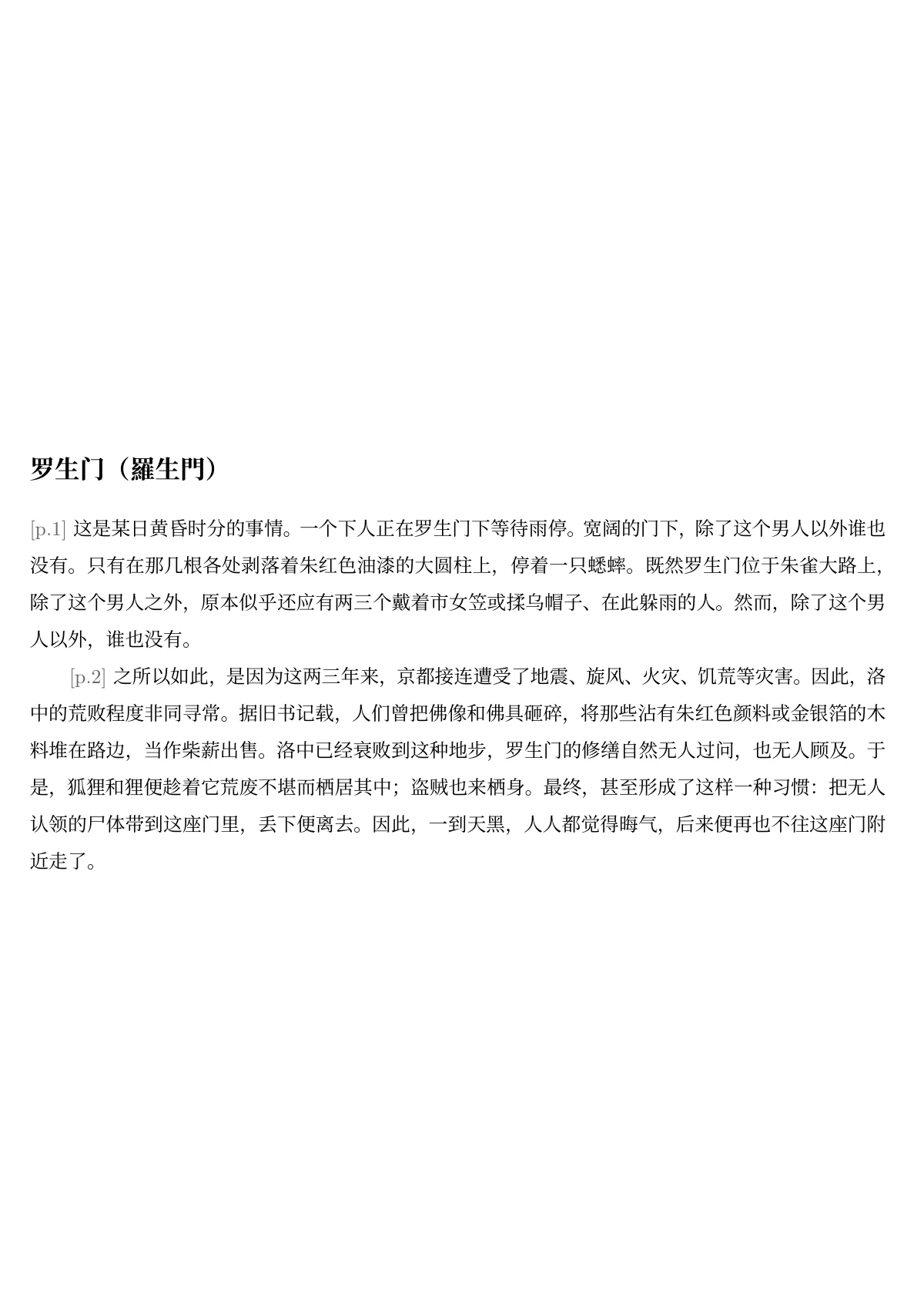 Vertical-book translation: page 1 of the 1917 edition and the reviewed opening paragraph in Simplified Chinese, without furigana mixed into the prose.
Processed through Geyi’s actual pipeline; the translation is manually checked and edited paragraph by paragraph. The display is an edited excerpt. · Source: Rashōmon, Ryūnosuke Akutagawa, 1917 (The author, Ryūnosuke Akutagawa, died in 1927, more than 70 years ago; under Japanese copyright law, works of authors who died before the end of 1967 were protected for 50 years after death, so protection of this book expired at the end of 1977. The National Diet Library Digital Collections marks the item PDM (Public Domain Mark) and publishes it online (DOI 10.11501/1088339).)
The first four paragraphs of Chapter I of the 1872 sixth-edition EPUB become Simplified Chinese, retaining chapter and section headings and paragraphs. The opening-page comparison previews ebook translation.

 EPUB chapter excerpt: opening pages of the English source and Simplified Chinese translation; long paragraphs continue naturally across output pages.
Generated through Geyi’s pipeline, then checked against the source and edited for display. These are excerpts; translations are in Simplified Chinese. · Source: The Origin of Species · sixth-edition EPUB, Charles Darwin, 1872 (The 1872 sixth edition; excerpted from the supplied Standard Ebooks EPUB, whose electronic edition includes a CC0 dedication.)
Frequently asked questions
What does a book cost?
Local formats (EPUB, Word, text) count 1,600 characters as a page, at 8 credits a page on high precision and 2 on standard. A 200,000-character book is roughly 125 pages — about 1,000 credits on high precision, or about 250 on standard. PDFs depend on the mode — see the PDF translation page.
Can I close the page part-way?
Yes. Jobs run in the background once submitted; closing the page does not affect progress, and the result waits in History.
What if names come out inconsistent?
Pin them in the personal glossary. It applies across jobs, so even chapter-by-chapter submissions stay consistent.
Can I translate several books at once?
Yes; how many run concurrently depends on your plan, and past the limit the page asks you to wait or upgrade.
Are credits refunded if a job fails?
Credits are only held while a job runs and are released automatically if it is cancelled or fails, so nothing is spent on a job that produced nothing.
Can I translate copyrighted books?
Only process files you are entitled to process. DRM-protected ebooks cannot be parsed, and whether translation and use are permitted depends on copyright law where you are.
Related
简体中文 · Français · Deutsch · Русский · 日本語 · 한국어 · العربية · 繁體中文
Geyi is a proprietary AI document platform owned and operated by Nayuta Technology and Culture Company Limited.